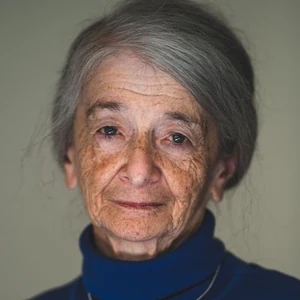
 Henriette Kretz was born on October 26, 1934, into a Jewish family in the then-Polish city of Stanisławów (today Ivano-Frankivsk, Ukraine). Her father was a physician and her mother a lawyer. Henriette grew up in a loving household and enjoyed a carefree childhood in a small town in southern Poland.
After the German invasion of Poland in the autumn of 1939, the family fled to Lviv (then Lwów), where her parents’ families lived. Soon afterward, Henriette and her parents moved to the nearby town of Sambir. Her father became the director of a sanatorium for children with tuberculosis. However, in 1941, the war and German occupation also reached them there. They were evicted from their home and forced to move into the Jewish quarter, where a ghetto was soon established.
Constantly exposed to danger, Henriette’s father repeatedly managed to save his family, bribing officials or relying on Ukrainian acquaintances to prevent their execution and secure their release from imprisonment. Eventually, however, the family’s hiding place in a Christian household was betrayed. Henriette’s parents were shot before her eyes. She herself survived by hiding in a convent.
After the war, she made her way to Antwerp and later became a French teacher in Israel. In 1969, she returned to Antwerp. Henriette is widowed, has two sons, three grandchildren, and one great-grandchild. She is a member of the Polish association “Children of the Holocaust” and has been active as a contemporary witness for more than 20 years.