
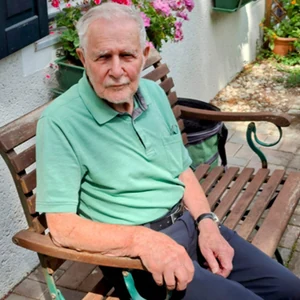
René Kaufmann
René Kaufmann was born in 1937 in Belgium to a Catholic mother and a Jewish father. The Nazis classified their marriage disparagingly as a “mixed marriage,” prompting his parents to flee from Germany first to the Netherlands and later to Belgium in 1934. René thus grew up with his two siblings in Belgium, a country to which he remains deeply attached—he still attends school reunions there and speaks both Flemish and French.
After the Wehrmacht occupied Belgium in 1940, René’s family was subjected to Nazi violence. Fearing deportation, his father hid in the Ardennes, where he survived but was critically wounded by a physician. René and his siblings narrowly escaped deportation themselves, though they lived under constant threat. His mother was abused by the Nazis for refusing to reveal her husband’s hiding place.
René vividly recalls these events, including the abduction of his aunt, who was dragged from her bicycle before his eyes and later deported to Auschwitz—where, like most of the Jewish side of his family, she was murdered. Liberation by American troops in 1944 remains a joyful memory for him; the children were given large jars of candy.
In 1957, at age 20, René regained German citizenship and returned to Germany—ironically, he was immediately conscripted into the Bundeswehr, where some of his superiors still harbored Nazi sympathies. For many years, René was unable to speak about his family’s history, but more recently, he and his sister Paula Maline have begun sharing their testimony with school groups. René now lives with his wife Mechthilde in Moosburg an der Isar.